
Initio INIC-3607EN Data Recovery
Many external hard drives use the INIC-3607EN chip to convert USB 3.0 signals into SATA commands for the internal disk. When this chip fails, the drive can stop working even if the data is still intact. At Zero Alpha, we regularly bypass this controller to access the drive safely and recover the customer’s files.
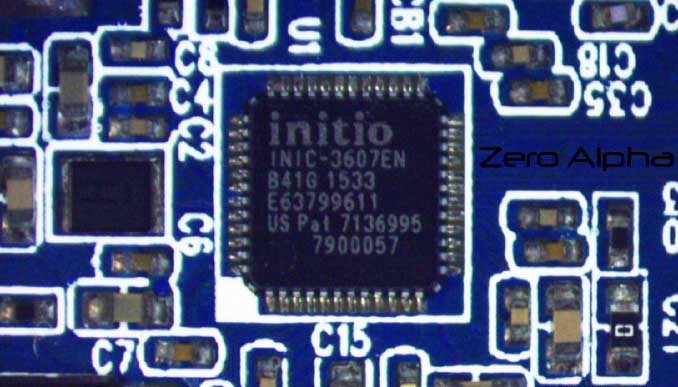
INIC-3607EN Technical Details
- USB 3.0 → SATA II bridge controller (SuperSpeed USB support)
- Backward compatible with USB 1.0 / 1.1 / 2.0
- SATA 2.6 compliant (3 Gb/s SATA interface)
- Supports BOT (Bulk-Only Transport) mass-storage mode
- Supports UASP (USB Attached SCSI Protocol) for improved performance
- Contains 32-bit CPU core, USB PHY, SATA PHY, data buffer, and AES engine
- Available in 48-pin QFN and 64-pin LQFP packages (6 mm × 6 mm size)
- Requires firmware to operate; corruption can cause detection failures
- Commonly used in USB enclosures, portable drives, and SATA adapters
Data sheet & Pinout
Initio INIC-3607EN Pin Code HDD Data Recovery Caselog
05Dec25: This portable usb hard drive has a 4 digit pin code security lock. The encryption board uses the last 20656 sectors to store meta data. The first sector has some unchanging data. 4 sectors into 20656 has the key in the first 4 lines which unchanges. The last 20656 sectors are hidden and have the encrypted Data Encryption Key (DEK). The DEK appears to be randomly generated when the enclosure is set up (using same pin gives different DEK). The Key Encryption Key (KEK) will be derived from the pin with some (proprietary) algorithm. Changing the passcode just re-encrypts the DEK with the new KEK and saves in the metadata. The metadata on the patient drive is intact. Moving it to a donor and attempting to unlock with the pin provided by customer (1234 example) does NOT successfully unlock the drive. Either the pin is wrong or the metadata is corrupt (seems highly unlikely). If you did tonnes of highly highly complex reverse engineering you could probably build a tool to brute force the passcode (all 10^12 + possibilities). BUT thats only useful if the original DEK is still there. if the enclosure was programmed with a new key, then it's impossible to get the data back. You can't bruteforce AES-256 keys.
